Gamma Index: Performance and Limitations
The gamma index implementation in DoseMetrics is algorithmically correct and validated against established medical physics literature (Low et al. 1998). However, the current implementation has significant performance limitations for large volumes that users should be aware of.
How the Gamma Index Works
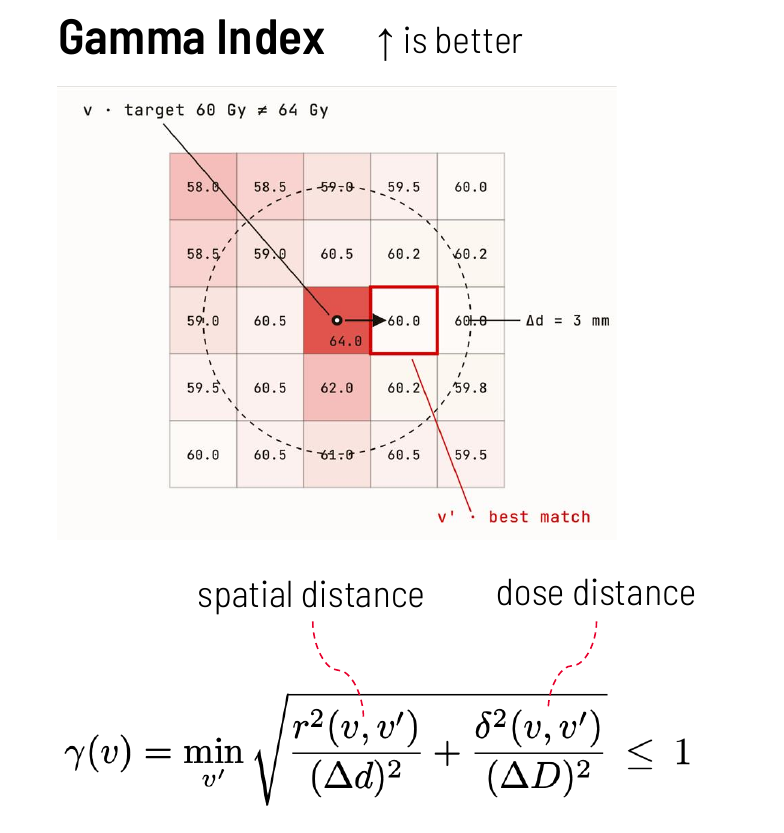 Gamma Index — for each voxel v, the index searches for the reference voxel v′ that minimises the combined spatial distance r(v, v′) / Δd and dose distance δ(v, v′) / ΔD. The voxel at 64 Gy (centre of the highlighted grid) fails because no reference neighbour within Δd = 3 mm matches its dose within ΔD. (Joseph Weibel, MSc Thesis Defense, University of Bern)
The gamma index at a point $v$ is:
$$\gamma(v) = \min_{v'} \sqrt{\frac{r^2(v, v')}{(\Delta d)^2} + \frac{\delta^2(v, v')}{(\Delta D)^2}} \leq 1$$
where $r(v,v')$ is the Euclidean distance between voxels, $\delta(v,v')$ is the absolute dose difference, $\Delta d$ is the distance-to-agreement criterion (e.g. 3 mm), and $\Delta D$ is the dose-difference criterion (e.g. 3% of prescription). A voxel passes when $\gamma \leq 1$.
Current Performance
| Volume Size | Voxels | Runtime | Clinical Target | Status |
|---|---|---|---|---|
| 32³–64³ | ≤ 262K | < 10s | Acceptable | OK |
| 128³ | 2.1M | ~53s | < 10s | Slow |
| 256³ | 16.8M | ~400s | < 10s | Too slow |
The bottleneck is a triple-nested Python loop that accounts for ~99% of runtime. No parallelization is used.
What Works Well Now
The 3D gamma computation is reliable for:
- Small volumes (32³ to 64³): completes in < 10 seconds
- 2D gamma (
compute_2d_gamma()): fast for per-slice QA - Research and batch processing where runtime is not interactive
The implementation handles all standard clinical criteria correctly:
- 1%/1mm (research / strict)
- 2%/2mm (tight clinical)
- 3%/3mm (standard clinical)
- 5%/3mm and 3%/5mm (lenient)
Workarounds for Large Volumes
Until the performance issues are resolved, these approaches make the current implementation usable:
1. Use 2D gamma for interactive QA:
from dosemetrics.metrics import gamma

gamma_2d = gamma.compute_2d_gamma(
    dose_ref_slice,
    dose_eval_slice,
    dose_criterion_percent=3.0,
    distance_criterion_mm=3.0,
    pixel_spacing=(1.0, 1.0)
)
2. Crop to the region of interest:
3. Downsample resolution (with caution — check that clinical accuracy is maintained):
# Use every other voxel for a quick QA check
dose_ref_downsampled = dose_ref.dose_array[::2, ::2, ::2]
4. Run overnight for large batch jobs: the algorithm is correct, just slow.
5. Reduce the search radius:
gamma_map = gamma.compute_gamma_index(
    dose_ref, dose_eval,
    dose_criterion_percent=3.0,
    distance_criterion_mm=3.0,
    max_search_distance_mm=6.0,  # Default is 3× criterion = 9mm; reducing helps
)
Optimization Roadmap
Performance optimization is planned in three phases:
Phase 1 — Multi-threading (target: 128³ < 15s)
Add n_jobs parameter using joblib for parallel processing across CPU cores. Low effort, immediate 2–4× speedup.
Phase 2 — Vectorization (target: 128³ < 5s)
Replace the Python triple loop with NumPy broadcasting and optional Numba JIT compilation. Larger engineering effort, 5–10× additional speedup.
Phase 3 — GPU acceleration (target: 128³ < 1s)
CuPy-based GPU implementation with automatic CPU fallback. Requires NVIDIA GPU with CUDA.
Algorithmic Correctness
The implementation has been validated with 24 correctness tests covering:
- Formula correctness (Low et al. 1998):
γ = sqrt((Δdose/DD)² + (distance/Dc)²) - Global and local normalization modes
- Dose threshold handling
- All standard clinical criteria
- Edge cases (zero dose, high-gradient regions, small volumes)
- Statistical functions (passing rate, comprehensive statistics)
The algorithm is correct. The only known issue is runtime performance for large volumes.
References
- Low DA, et al. (1998). "A technique for the quantitative evaluation of dose distributions." Medical Physics 25(5):656–61.
- Wendling M, et al. (2007). "A fast algorithm for gamma evaluation in 3D." Medical Physics 34(5):1647–54.
- Ju T, et al. (2008). "On the feasibility of GPU-based gamma evaluation." Medical Physics 35(10):4431–4438.