Homogeneity Metrics
Homogeneity metrics characterize uniformity within a target or dose falloff
around the prescription isodose. The four homogeneity.compute_* functions
are reference-free. Their named distances are reference-based.
Classification
| Metric | API | Reference use | Ideal or direction |
|---|---|---|---|
| Homogeneity index | homogeneity.compute_homogeneity_index |
Reference-free | Lower |
| Gradient index | homogeneity.compute_gradient_index |
Reference-free | Lower |
| Dose coefficient of variation | homogeneity.compute_dose_homogeneity |
Reference-free | Lower |
| Uniformity index | homogeneity.compute_uniformity_index |
Reference-free | Higher |
| Homogeneity index distance | compare_homogeneity_index |
Reference-based | Lower |
| Paddick gradient index distance | compare_paddick_gradient_index |
Reference-based | Lower |
Homogeneity index
For a target DVH, \(D_x\) is the dose received by at least \(x\%\) of the target volume. The implemented homogeneity index is:
It is dimensionless; zero represents a perfectly uniform target dose.
Homogeneity-index distance
Reference-based · compare_homogeneity_index · dimensionless · lower is
better.
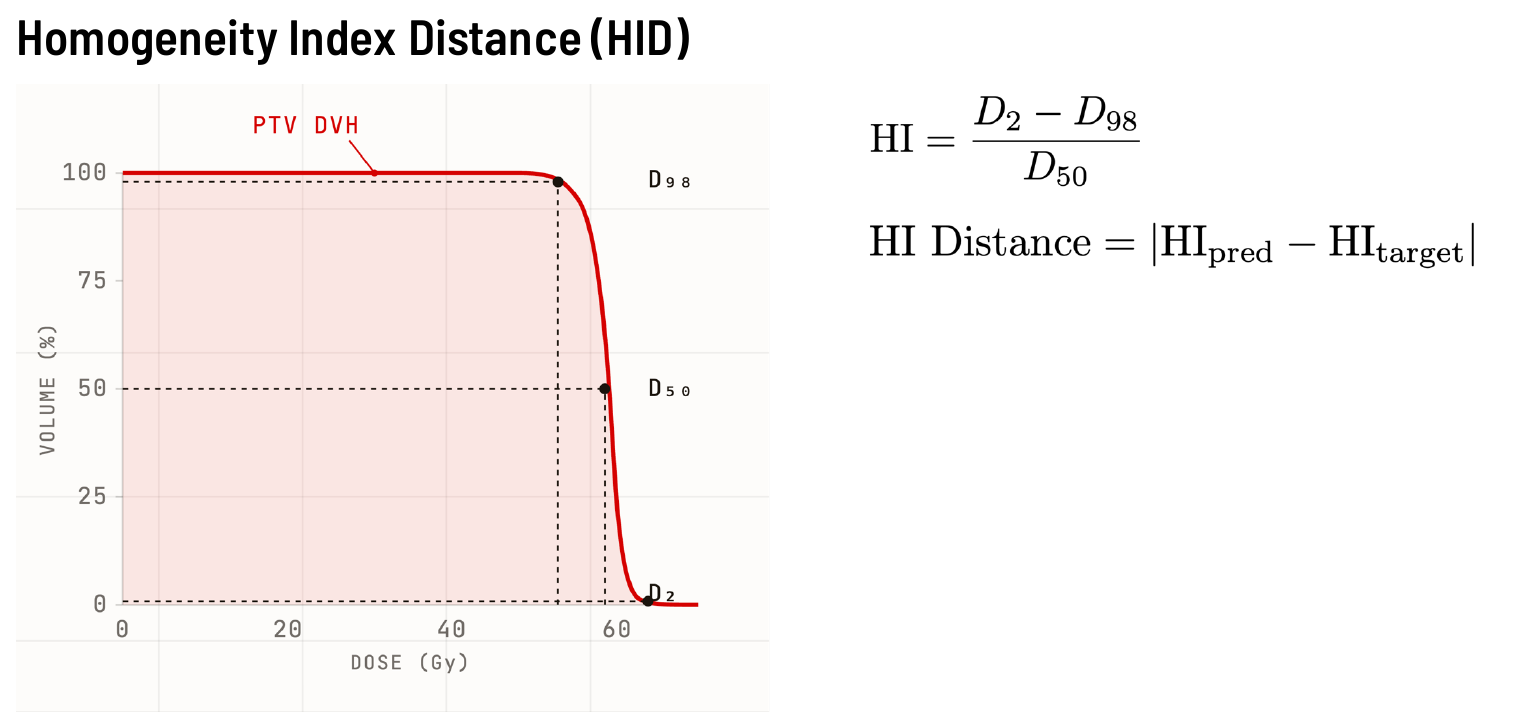 The same \(D_2\), \(D_{50}\), and \(D_{98}\) definition is evaluated for each target DVH.
from dosemetrics.metrics import compare_homogeneity_index

hid = compare_homogeneity_index(reference, evaluated, ptv_high)
Gradient index
The Paddick gradient index is the ratio of the volume receiving at least half the prescription dose to the volume receiving at least the full prescription dose:
The volume ratio is evaluated over the complete dose grid. The target
argument is retained for a consistent clinical call signature but does not
alter this implementation.
Paddick gradient-index distance
Reference-based · compare_paddick_gradient_index · dimensionless ·
lower is better.
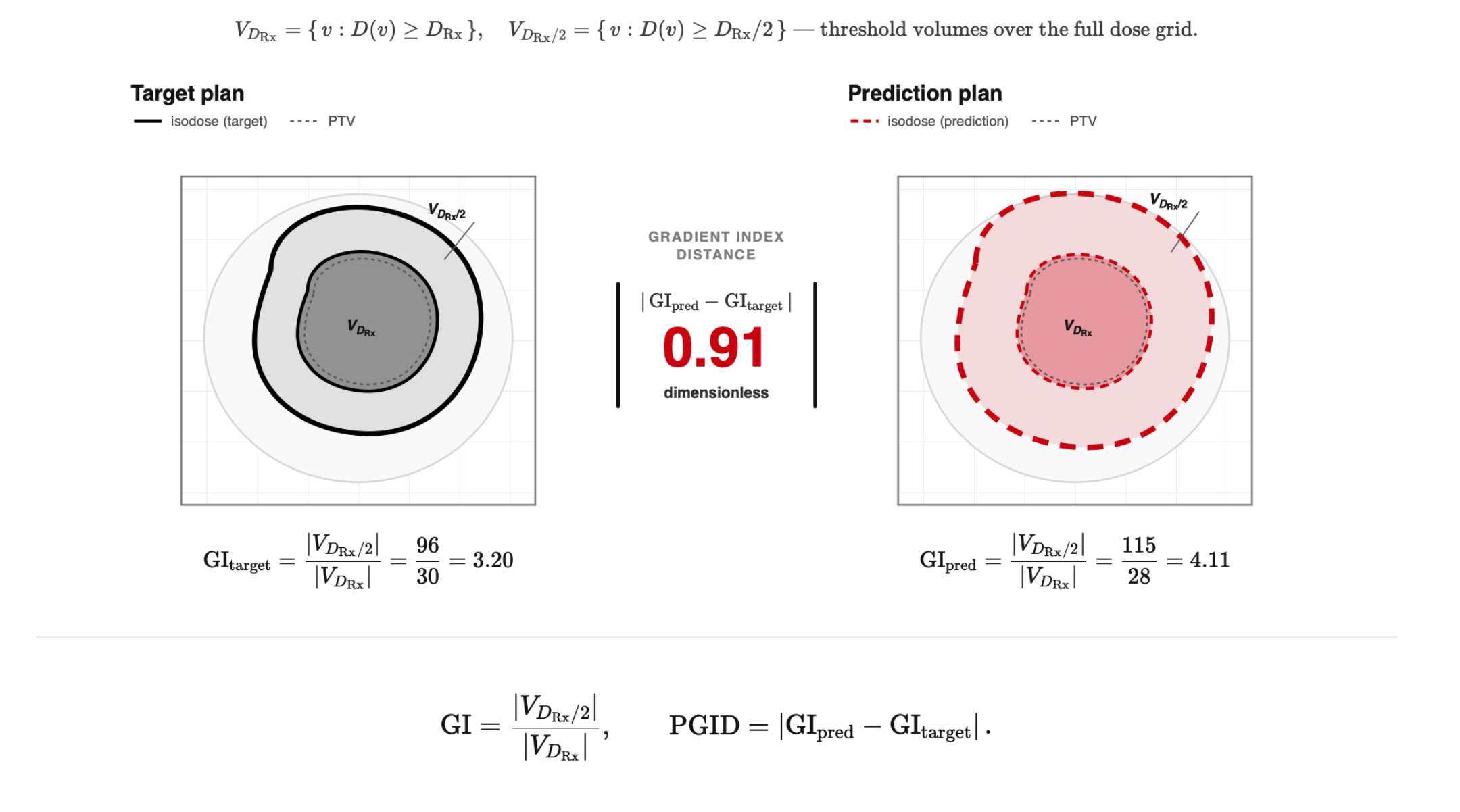 Full- and half-prescription isodose volumes are measured independently for each plan.
from dosemetrics.metrics import compare_paddick_gradient_index

pgid = compare_paddick_gradient_index(
    reference,
    evaluated,
    prescription_dose=70.0,
)
Dose coefficient of variation
compute_dose_homogeneity reports the coefficient of variation inside the
target:
Uniformity index
The implemented uniformity index uses the median target dose as its reference:
A perfectly uniform target has a value of 1. Large dose ranges can produce a negative value; the function does not clip the result.
Choosing a homogeneity measure
- Use
compute_homogeneity_indexfor a percentile-based target summary that is less sensitive to a single extreme voxel. - Use
compute_dose_homogeneityfor a distribution-wide coefficient of variation. - Use
compute_uniformity_indexwhen the full target minimum-to-maximum range is intentional. - Use
compute_gradient_indexfor dose falloff outside the prescription isodose, not for within-target uniformity.